
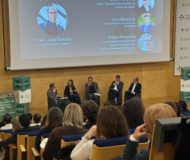
The Institute for Research Sant Pau (IR Sant Pau) has held a new edition of its Research Day, an annual event that consolidates the center as a leading reference in biomedical research and innovation at the service of health. The event, held in the auditorium of Hospital de Sant Pau, brought together researchers, healthcare professionals, institutional representatives, and experts from the research system to reflect on the major challenges and opportunities of hospital-based research.
The day was opened by Dr. Jordi Surrallés, Scientific Director of the IR Sant Pau, who welcomed attendees. Dr. Surrallés framed the meeting within the rollout of the 2025–2030 Strategic Plan, the year in which the strategic reflection initiated in recent years begins to translate into action and to transform the way IR Sant Pau operates. In his address, Dr. Surrallés also emphasized that «research cannot turn its back on society. Generating excellent knowledge is essential, but it is not enough: explaining what we do, why we do it, and what impact it has is part of our responsibility as a public research institution».
One of the first axes of the day was a discussion on the role of philanthropy in building the biomedical research ecosystem, with a lecture focused on analyzing how philanthropic support can make a decisive contribution to research development, especially in areas of high scientific and social impact.
The lecture was delivered by Àngel Font, Associate Director of Research and Fellowships at the “la Caixa” Foundation and Executive Director of the CaixaResearch Institute, who explained how the foundation provides sustained support for scientific and biomedical research, positioning it as a strategic priority. In this context, Font presented the CaixaResearch Institute as an example of how philanthropy can strengthen research excellence, foster collaboration between centers, and contribute to consolidating a competitive and sustainable research ecosystem, also at the European level.
This was followed by a roundtable discussion moderated by Dr. Jordi Surrallés and focused on the challenges and opportunities of hospital research institutes, with the participation of Dr. Begoña Benito, Director of the VHIR; Dr. Gabriel Capellá, Director General of the IDIBELL; Dr. Jordi Barretina, Director General of the IGTP; and Dr. Antoni Plasencia, Director General for Research and Health Innovation at the Department of Health of the Government of Catalonia. During the discussion, key issues were addressed such as the sustainability of research institutes, talent attraction and retention, and the need to strengthen environments that facilitate research excellence integrated within hospitals.
The central session of the morning was devoted to the value of independent clinical drug research, with the presentation of several academic clinical trials led by IR Sant Pau and funded through the Independent Clinical Research (ICI) call of the Instituto de Salud Carlos III. This session featured, among others, a multicenter, randomized, double-blind trial with donepezil in mild cognitive impairment associated with Parkinson’s disease; the AFAN trial, focused on repositioning afatinib in oral cancer in patients with Fanconi anemia; a study on the antidepressant effects of psilocybin analyzed through functional neuroimaging; the LESS-AD trial, with levetiracetam to prevent epileptic seizures in adults with Down syndrome and Alzheimer’s disease; several trials with academic CAR-T cells in hematologic neoplasms; and the SAVE trial, which compares sevoflurane and propofol in general anesthesia in patients with ischemic stroke treated with endovascular therapies.
This set of presentations highlighted IR Sant Pau’s role in the development of academic and multicenter clinical trials, with a clear translational orientation. In the words of Dr. Surrallés, «Sant Pau’s distinctive feature is the ability to integrate disciplines, connect basic and clinical research, and always keep the focus on the patient».
The day continued with a session dedicated to new leadership in translational research, led by early-career researchers with emerging trajectories linked to competitive national investigator stabilization programs. This session showcased projects addressing some of the major current challenges in biomedical research from a clearly translational perspective.
Specifically, initiatives were presented focusing on the application of data science to integrate environmental, infectious disease, and clinical data in health research; on modulating the tumor microenvironment to improve therapeutic outcomes in solid tumors; on integrating omics, clinical, and epidemiological approaches in women’s health; on advancing neuropsychological assessment in people with Down syndrome in the digital era; and on developing precision psychiatry strategies based on brain circuits.
This session reinforced IR Sant Pau’s commitment to scientific talent development and to creating opportunities for new generations of researchers to lead high-impact projects. As emphasized by the Institute’s Scientific Director, «the Strategic Plan places talent, career paths, and organizational culture at the center, because there is no research excellence without teams that are supported, recognized, and have a future perspective».
One of the main new features of this edition of the Research Day was the first-time inclusion of the outreach activity “240 seconds: my thesis in a flash”, which closed the day in the afternoon. This initiative gave prominence to doctoral candidates, who were challenged to explain their research orally in a maximum of four minutes, using clear, accessible language understandable to a non-specialist audience.
The activity was conducted in a format of consecutive short presentations, in which participants had to synthesize the objectives, methodology, and relevance of their research, emphasizing its application and potential impact. With this dynamic format, the session highlighted young researchers’ communication skills and contributed to bringing the research carried out at IR Sant Pau closer to the center’s scientific community and to society as a whole.
The closing lecture of the morning block was delivered by Dr. Ari Melnick, Director of the Josep Carreras Leukaemia Research Institute, who presented a talk focused on pathogenesis and targeted therapies in immune neoplasms.
In his presentation, Dr. Melnick addressed the molecular and immunological mechanisms involved in the development of these diseases, as well as recent advances in targeted therapies and their translational potential in clinical practice, highlighting how mechanistic knowledge is opening the door to increasingly specific and personalized treatments in the field of hematologic neoplasms.
The day concluded with an institutional closing ceremony with the participation of Dr. Adrià Comella, Managing Director of Hospital de Sant Pau, and Dr. Jordi Surrallés, Scientific Director of IR Sant Pau, during which reflections were shared on the present and future challenges of hospital-based research. With this new edition of the Research Day, IR Sant Pau reaffirms its commitment to scientific excellence, independent research, and knowledge transfer, consolidating its position as a key player within the biomedical research system and as a driver of continuous improvement in healthcare. In his closing message, Dr. Surrallés recalled that «2025 is not an endpoint. It is a starting point. The challenge now is to consolidate the transformation, stay the course, and do it together».

