
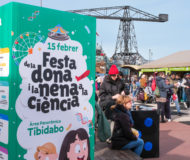
The second edition of the Women and Girls in Science Celebration, organized this Sunday by the Sant Pau Research Institute (IR Sant Pau), once again transformed the Panoramic Area of Tibidabo Amusement Park into a meeting space between science and the public. More than 4,000 people attended throughout the day to accompany Mariona, an eight-year-old girl passionate about science, in this celebration held in the framework of the International Day of Women and Girls in Science.
During the event, families enjoyed more than twenty educational and participatory workshops and activities led by professionals from IR Sant Pau, helping to raise awareness and promote a more inclusive future in science. The project also highlights the role of women in science, showcasing real examples of female researchers who share their professional and personal experiences with the goal of promoting gender equality in this field.
At IR Sant Pau, the commitment to gender equality is also reflected in the structure of its research staff. Women represent 65% of research personnel in the R2 and R3 categories, 67% of early-stage researchers, and 44% of those leading research groups. Likewise, female representation is the majority in management teams and in scientific-technical platforms, at 80% and 83%, respectively. These figures demonstrate strong female participation at all stages of the scientific career.
Dr. Jordi Surrallés, director of IR Sant Pau, highly valued the celebration of this second edition. “We want girls and boys to see that science is accessible, exciting, and also a space for them. Creating female role models from an early age is key to building more diverse and more excellent research,” he stated.
The Minister of Health of the Government of Catalonia, Olga Pané, underscored the importance of initiatives like this to advance toward a more inclusive and equitable science. “It is essential to maintain the scientific spirit and encourage our girls to continue in the field of science. We have made significant progress, but we have not yet reached where we want to be. We need more women researchers, more women leading teams, and more women in decision-making positions. The science of the future must include everyone’s talent, because only then will it be better and fairer.”
The minister also noted that female representation in research has grown significantly lately, although inequalities persist at leadership levels. “Today, women account for more than 50% of doctoral students, and three-quarters of healthcare professionals are women. However, this same representation is not yet fully reflected in executive leadership positions. That is why it is essential to continue promoting role models, breaking stereotypes, and defending science against any form of denialism.”
Finally, she issued a collective call to protect and elevate scientific research as a driver of social progress. “Science is a tool for protection and progress. We must defend and value it, especially in the face of narratives that question it. Events like this not only inspire vocations but also help build a more equal and stronger future for our country.”
A Day Filled With Activities
The event offered a wide variety of proposals designed to bring science and research closer to audiences of all ages. Among the most notable activities were workshops such as The Superpower of Blood and Discovering the Basis of Life — DNA, where participants were able to explore fundamental concepts of biomedicine practically.
Sessions such as Experience Science by Conducting Experiments! were also held, along with workshops on the influence of sex and gender on medication response and spaces dedicated to understanding how the respiratory, digestive, and cardiovascular systems function. The activity I Want to Have a Super Heart! focused on the importance of healthy habits from childhood.
Hands-on learning also played a central role with a cardiopulmonary resuscitation (CPR) workshop, which allowed children and adults to become familiar with basic life-saving maneuvers. For younger audiences, activities such as My Body Is Awesome! and the session How Are Babies Born? addressed different aspects of development and health from a scientific and educational perspective.
The day also featured the space The Human Body: A 3D Journey, with three-dimensional models that allowed visitors to explore organs and systems visually and interactively, in addition to scientific animations and recreational activities for younger children.
Children who had completed the Mariona project missions throughout the year were able to exchange their wristbands for a personalized calculator featuring Mariona’s image, a gift from Casio, reinforcing the experiential and ongoing nature of the initiative. In the words of Dr. Jordi Surrallés, “Initiatives like this are part of our responsibility as a research institute: to open our doors, share knowledge, and actively contribute to a more informed and equitable society.”
The Mariona Project
The “Mariona Researcher” project is an educational and outreach initiative developed by IR Sant Pau. Mariona is a character who symbolizes an eight-year-old girl passionate about science and medicine, with the purpose of inspiring girls, boys, and young people to explore the world of scientific research. Around this age—eight years old—is when girls often begin to lose interest in science, due both to persistent stereotypes and to the lack of role models, a situation this project seeks to address.
Science With a Gender Perspective
IR Sant Pau continuously promotes dialogue with society, aligned with its RRI plan and its objectives in scientific education and citizen participation. As a CERCA center and as a Unit of Scientific Culture and Innovation accredited by FECYT, its commitment to bringing research closer to society is firm. As the only Catalan research institute with a cross-cutting research program in gender, IR Sant Pau serves as a spokesperson for the latest scientific advances and highlights the importance of research with a gender perspective. It also highlights women’s role in research and the future of science.
For its part, Tibidabo Amusement Park, known for its dedication to educational and charitable projects, collaborates with various organizations to give visibility to missions with significant social impact. In this context, the park is an ideal venue to showcase IR Sant Pau’s work to families.
Several companies also participated in this Women and Girls in Science Celebration. The second edition of the event was supported by Casio, GAES Junior, Grupo Julià, Miniland, and Tais Events. DiR, Dansa Menchu Durán, the Guinardó Municipal Sports Center, and MODIband also took part, contributing to the development of various activities throughout the day.

