
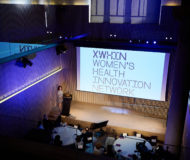
Despite advances in biomedical research, women’s health remains underrepresented in many areas of innovation and clinical practice, with gaps in diagnosis, treatment, and knowledge generation. To address this challenge, the XWHIN (Women’s Health Innovation Network) was created, led by the Institut de Recerca Sant Pau (IR Sant Pau). On April 24, it held its first public working session at the Sant Pau Art Nouveau Site as part of the scientific meeting “Entre Dones,” with the participation of more than 80 professionals. This participatory event on women’s health, organized by Hospital de Sant Pau, provided a space to discuss, share, and learn about women’s health from a gender perspective.
The meeting was opened by Lourdes Puigbarraca, Deputy Director General for Transfer and Society of the Government of Catalonia, and included a presentation of the network by Dr. Maria Rosa Ballester, Head of Responsible Research and Innovation at IR Sant Pau and Director of XWHIN. The session was structured around short talks by experts from different fields, discussion spaces, and co-creation dynamics, with the aim of fostering interdisciplinary dialogue and identifying opportunities to advance the integration of sex and gender perspectives in health research and innovation.
The meeting also served to present the network’s visual identity and to outline its strategic objectives, aimed at promoting a new way of conducting research and innovation in women’s health. As Dr. Ballester highlights, “the creation of XWHIN responds to the need to systematically incorporate sex and gender perspectives into health research and innovation,” and this first gathering “has been the first step in activating a network that seeks to generate useful knowledge and drive innovation projects with real impact on women’s health and on the population in all its diversity.”
XWHIN positions itself as a pioneering initiative that systematically integrates this perspective across all phases of R&D&I, with the goal of generating more equitable solutions with real impact on clinical practice and society. The network is funded by the Agency for Management of University and Research Grants (AGAUR) of the Department of Research and Universities of the Government of Catalonia.
During the first part of the meeting, seven specialists from different fields—oncohematology, neurovascular health, mental health, cardiovascular health, epidemiology and public health, primary care, and reproductive health—shared, in five-minute presentations, the key challenges in their areas to advance innovation in women’s health by integrating sex and gender perspectives into research and clinical practice.
The presentations provided a broad and complementary overview of current challenges. Across the board, they highlighted the need for more representative data and for the integration of sex and gender perspectives from the earliest stages of research through to their translation into clinical practice. It was also emphasized that the absence of this perspective generates scientific bias and has direct consequences for diagnosis, treatment, and equity in healthcare. In this regard, the talks underscored the importance of promoting interdisciplinary approaches capable of integrating the complexity of biological, clinical, and social factors that influence health, moving toward more precise, inclusive solutions adapted to population diversity.
Overall, the presentations showed that progress in this direction requires a shared vision and greater coordination among the different stakeholders in the ecosystem, including research, clinical practice, innovation, and society, laying the groundwork for collaborative workspaces aimed at identifying opportunities and activating new lines of action.
The meeting continued with a collaborative working session in which participants organized into groups to identify needs, opportunities, and potential lines of action, using a participatory methodology.
Among the main areas of reflection, participants highlighted the need to make data more visible and accessible, as well as to promote its generation based on criteria that incorporate sex and gender perspectives. They also pointed to the importance of advancing shared standards for data collection and use and of developing mechanisms to facilitate its application in research and clinical practice.
In addition, the need to align funding mechanisms with this perspective and to strengthen coordination across different levels of the system—from public policy and institutions to clinical practice and research—was emphasized. The discussion also highlighted the value of promoting cultural and organizational changes that support its integration, including the development of role models, citizen participation, and increased awareness among professionals.
The conclusions drawn by the groups formed a first map of shared priorities that will guide XWHIN’s strategic plan in the coming months, with the aim of promoting coordinated actions with real impact on the system.
This meeting marks the starting point of XWHIN’s public activity, a pioneering network in Catalonia designed to connect the different stakeholders in the ecosystem—research, clinical practice, innovation, industry, and patients—and to create a stable collaborative space aimed at transforming the way women’s health is addressed. This first gathering made it possible to share knowledge, identify common challenges, and begin defining joint lines of work to address identified needs.
With this approach, XWHIN promotes a model that systematically integrates sex and gender perspectives across all phases of R&D&I, from knowledge generation to its application in clinical practice. The network is created with the aim of reducing existing health inequalities and promoting more precise, inclusive innovation aligned with the specific needs of the population, fostering collaborative projects with the capacity to generate real impact on the healthcare system.

