
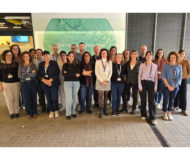
The new XWHIN (Women’s Health Innovation Network), coordinated by the Institut de Recerca Sant Pau (IR Sant Pau), has been established with the support of the Agency for the Management of University and Research Grants (AGAUR), which has awarded funding of 1 million euros under the Xarxes d’R+D+I 2025 call. This initiative represents a recognition of IR Sant Pau’s leadership in responsible research with a gender perspective and strengthens its role as a key player in Catalonia’s health R&D&I ecosystem.
XWHIN is the first network in Catalonia and Spain to integrate R&D&I, gender equity, technology transfer, and social participation in women’s health. Its pioneering nature lies in the systematic incorporation of the biological and social dimensions of sex and gender across all innovation processes, generating ethical, efficient, and equitable solutions. At the European level, no other network exists with such an integral approach, placing Catalonia in a leadership position in this emerging field.
The initiative was created with the aim of promoting a new way of doing science, one that is more collaborative, open, and sensitive to the biological and social differences that affect women’s health. “With XWHIN, we aim to foster a change in perspective that integrates sex and gender into every stage of health innovation, from basic research to clinical and social application,” explains Dr. Maria Rosa Ballester, head of the Responsible Research and Innovation Unit (URRI) at IR Sant Pau and director of the network. “The project seeks to position Catalonia as a European benchmark in gender-sensitive health innovation, leveraging the country’s scientific and technological strengths and its tradition of excellence in biomedical research.”
Despite scientific and social progress lately, women continue to experience structural health inequalities at multiple levels, from research and diagnosis to access to treatment or participation in clinical trials. Cardiovascular, neurological, or autoimmune diseases, for example, impact women and men differently, yet medical protocols and available studies often fail to reflect these differences.
On top of these biological gaps, social and cultural factors shape women’s health and well-being, including gender roles, caregiving burdens, and the invisibility of pain and conditions that predominantly affect them. The lack of sex- and gender-disaggregated evidence directly impacts the quality and equity of healthcare and limits the system’s ability to provide personalized and effective responses.
In this context, XWHIN was created to address and reverse these inequalities by promoting a global and interdisciplinary vision of women’s health. The network will promote high-impact scientific, technological, and social projects to identify unmet needs, generate new knowledge, and transfer it to clinical practice and public policies. The network’s director notes that “the sex and gender perspective is essential for better understanding diseases, how drugs work, and for offering responses that are more just, safe, effective, and equitable.” She adds, “With XWHIN, we want to transform the way we think about research and care, and how we approach health—placing women at the center of innovation and promoting research that reflects the true diversity of society.”
The XWHIN network is the result of an unprecedented alliance between public institutions, universities, research centers, companies, and social organizations. Altogether, it comprises 47 research groups and 8 collaborating organizations working in areas related to women’s health and health innovation. This open and cross-cutting structure will make it possible to address women’s health challenges from multiple perspectives—biomedical, technological, social, and economic—yielding more integrated and effective responses.
The network is coordinated by IR Sant Pau and includes participation from leading research centers and universities across the region, as well as companies and foundations in the health and technology sectors and patient organizations. “The value of XWHIN lies in its ability to connect disciplines and institutions that traditionally worked in isolation,” explains Dr. Maria Rosa Ballester. “This network seeks to create real synergies between research, industry, and society, transforming knowledge into tangible solutions that improve women’s health and well-being.”
IR Sant Pau had already taken a major step in this area in 2023 with the creation of the Transversal Program for Research in Women’s and Gender Health. This pioneering initiative in Catalonia aimed at incorporating sex and gender perspectives into all its research areas. The program, developed within the framework of the Responsible Research and Innovation (RRI) Plan, provides the methodological framework and tools needed to integrate this perspective into all projects—from basic research to clinical and public health research.
Coordinated by Dr. Elisa Llurba, head of the Women’s and Perinatal Medicine Research Group at IR Sant Pau and director of the Obstetrics and Gynecology Department at Hospital Sant Pau, together with Dr. Maria Rosa Ballester. The program channels research initiatives on women’s health. It promotes collaboration between groups and supports the attraction of talent and funding in this field.
According to Dr. Elisa Llurba, “prioritizing the sex and gender perspective in biomedical research not only makes science more ethical and responsible, it also makes it more reproducible and increases its quality and its ability to generate useful results for the entire population.”
This trajectory strengthens IR Sant Pau’s leadership in gender-perspective research and lays the foundation for collaborative projects such as XWHIN, which represent a further step toward building more just, inclusive, and socially impactful biomedical research.
The development of XWHIN is structured around four areas of action that translate its vision into concrete and measurable objectives. The first is responsible research and innovation, which integrates sex and gender perspectives into all project phases, from experimental design to clinical application. With this approach, XWHIN seeks to ensure that research results reflect the biological and social diversity of the population, contributing to more equitable and personalized care.
The second area focuses on training and capacity building, aiming to prepare professionals to incorporate gender perspectives into their work. The network will promote specialized training programs, awareness-raising initiatives, and spaces for exchange among researchers, clinicians, and policymakers, fostering a more inclusive scientific culture committed to equality.
The third area centers on knowledge transfer and valorization, promoting collaboration between research groups, companies, and public institutions to translate science into applicable solutions. XWHIN will encourage the creation of entrepreneurial projects and spin-offs with the potential to improve women’s health and reduce inequalities, thereby strengthening an innovation ecosystem that delivers social and economic impact.
Finally, the fourth area is communication and awareness, aimed at highlighting the importance of integrating gender perspectives in health and engaging the public in transforming the healthcare system. The network will work to bring scientific knowledge closer to society and foster public debate on the specific challenges of women’s health.
According to Dr. Ballester, “These four areas define a very practical, results-oriented way of working, with a clear commitment to transforming research into tangible improvements. We want to show that integrating the gender perspective is not only a matter of equity but also of efficiency and scientific quality.”
With the creation of XWHIN, Catalonia takes a major step toward becoming a European benchmark in health innovation with a sex and gender perspective. The network is born with a clear ambition for international collaboration and plans to establish partnerships with European programs such as Horizon Europe or EU4Health, as well as with other leading women’s health networks and centers worldwide.
This global approach will enable knowledge exchange, promotion of best practices, and joint projects that will position Catalonia on the map of gender-sensitive biomedical innovation. In addition, the network seeks to actively contribute to European equality and public health strategies by providing a reproducible model of responsible, transversal, and sustainable R&D&I.
From IR Sant Pau, as the coordinating entity, scientific coherence and social impact will be ensured so that the network’s results extend beyond the academic sphere and generate real benefits for society. Through this collective effort, XWHIN aims not only to generate scientific, economic, and social impact but also to inspire new public policies and consolidate Catalonia as a European leader in gender-perspective innovation.
Coordinating Entity
Participating Institutions
Collaborating Entities

