
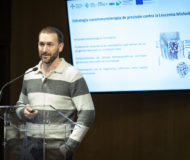
In acute myeloid leukemia, one of the main challenges is preventing relapse: although many patients respond to the initial treatment, leukemic stem cells capable of reactivating the disease may persist. To address this problem, Dr. Ugutz Unzueta, a researcher in the Oncogenesis and Antitumor Drugs Group at the Sant Pau Research Institute (IR Sant Pau), is leading the development of a precision nanoimmunotherapy designed to eliminate these resistant cells selectively. The project is supported by the Miquel Rutllant Fellowship, endowed with €100,000 and lasting two years, which has just been renewed for its second year following an event organized by the Fundació d’Investigació Salut i Progrés (FISP).
During the renewal meeting, Dr. Unzueta presented the progress achieved during the first year of work and outlined the next stages of a research effort aimed at improving patient prognosis through more selective and potentially less toxic therapies.
The Miquel Rutllant Fellowships aim to support biomedical research projects with potential clinical impact and to promote the development of new therapeutic strategies against complex diseases. These grants help consolidate innovative research lines and generate results that may later be translated into clinical practice.
Acute myeloid leukemia is a rare hematological malignancy characterized by the uncontrolled proliferation of immature cells in the bone marrow. Although many patients initially respond to induction chemotherapy, a significant proportion may experience relapse due to the persistence of leukemic stem cells that remain anchored and protected within the bone marrow microenvironment.
“Our goal is to directly target the origin of relapse. If we manage to eliminate the leukemic stem cells that survive treatment, we could significantly change the prognosis for these patients,” explains Dr. Unzueta.
Among the mechanisms that promote the survival of these cells is the CXCR4 receptor, which is involved in their interaction with the bone marrow microenvironment. It is associated with poorer prognosis and a higher risk of relapse when expressed at high levels. The strategy developed by the IR Sant Pau team uses multivalent protein nanoconjugates capable of specifically recognizing cells that express CXCR4. These nanoparticles act as precision delivery vehicles and carry a highly cytotoxic molecule that is released once the nanoconjugate has been internalized by the tumor cell.
“This technology allows us to deliver a very potent drug directly to leukemic cells expressing CXCR4, increasing treatment efficacy and potentially reducing damage to healthy tissues,” the researcher notes.
At this stage of the project, the team will evaluate the activity of the nanoconjugate in samples from patients with acute myeloid leukemia obtained at Hospital de Sant Pau. The objective is to determine the level of CXCR4 expression required to observe a therapeutic effect and, in doing so, move toward a model for selecting patients with the highest likelihood of response.
In addition, the researchers will study its efficacy in immunocompetent murine models and its ability to induce immunogenic cell death, a mechanism that could help activate the immune response against leukemic cells. Its potential in combination with immune checkpoint inhibitors will also be explored to identify therapeutic strategies with possible synergistic effects.
“If we can confirm these results, we could move toward much more selective and personalized therapies specifically targeting the cells responsible for relapse in acute myeloid leukemia,” concludes Dr. Unzueta.

