
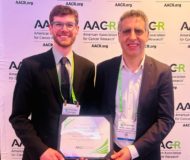
Dr. Manel Esteller, head of the Cancer Epigenetics group at the Institut de Recerca Sant Pau (IR Sant Pau), has been recognized by the American Association for Cancer Research (AACR) with the award for the best article published in the past two years in the journal Cancer Research Communications. This is in recognition of work that provides a significant advance in the understanding of myelodysplastic syndromes and in the ability to anticipate patient response to current treatments. The study was conducted during Dr. Esteller’s tenure at the Josep Carreras Leukaemia Research Institute (IJC).
“This recognition highlights not only the technological innovation of the study but also its potential clinical impact in a group of patients where there is still a significant need to improve therapeutic outcomes,” says Dr. Manel Esteller.
The study focuses on myelodysplastic syndromes, a group of hematologic diseases characterized by abnormal production of blood cells and with a risk of progression to acute leukemia. In these patients, hypomethylating agents—such as azacitidine—constitute the standard treatment, although approximately half of cases do not respond to this therapy, significantly limiting clinical options.
The award-winning work introduces an innovative approach based on single-cell technologies that allows simultaneous analysis, in each individual cell, of both genetic mutations and protein expression. This multi-omics strategy provides a much more precise view of tumor heterogeneity and disease evolution, overcoming the limitations of conventional analyses.
Thanks to this methodology, researchers were able to reconstruct in great detail the clonal architecture of the disease and its evolution before and after treatment, analyzing bone marrow samples from patients at different stages of the clinical process. This approach made it possible to track the different tumor cell populations—or clones—and identify how they change in response to therapy.
Unlike conventional analyzes, which study the overall cell population in aggregate, this technology allows the tumor to be broken down into its individual units and to simultaneously characterize genetic mutations and protein expression in each cell. In this way, it is possible to understand not only which alterations are present, but also in which cell types they occur and how they combine with each other.
“Until now, we analyzed the tumor as a whole, but this technology allows us to see what happens in each individual cell and understand how mutations and proteins interact in real time,” explains Dr. Manel Esteller. “This gives us a much more precise picture of the disease and its behavior.”
The results prove that the therapeutic response does not depend on a single genetic alteration but rather on the combination of different cellular lineages and mutational profiles that coexist within the same patient. This integrated view makes it possible to identify complex biological patterns that previously went unnoticed and that are directly related to disease evolution and treatment efficacy.
In addition, the study demonstrates that patients who respond to treatment show a significant reduction in mutated cellular clones following administration of epigenetic therapy, whereas in non-responding patients these clones persist or even expand. This finding provides a solid biological basis for understanding why some patients benefit from treatment while others do not, and opens the door to more personalized strategies.
“This knowledge allows us to begin identifying which patients are more likely to respond to treatment before it is initiated,” notes Dr. Esteller. “It also helps us understand the mechanisms underlying resistance, which is key to developing new therapeutic strategies.”
In parallel, the results highlight that clonal heterogeneity is already present from the time of diagnosis and that its evolution conditions treatment efficacy. The ability to track these changes at the single-cell level also makes it possible to identify which cell populations persist after therapy and may be behind treatment resistance.
Beyond its methodological value, the work identifies potential response biomarkers and points to new therapeutic vulnerabilities that could be exploited through drug combinations or targeted therapies. Overall, the findings suggest that integrated analysis of genetic and protein data at the single-cell level may become a key tool to guide clinical decision-making in these patients.
“The next step is to translate this type of analysis into clinical practice to make more informed and patient-tailored therapeutic decisions,” concludes Dr. Esteller. “We are closer to truly personalized medicine in complex hematologic diseases such as this.”
This international recognition highlights both the technological innovation of the study and its potential clinical impact in a field where there is still a significant need to improve treatment selection and patient prognosis.
Campillo-Marcos I, Casado-Pelaez M, Davalos V, Ferrer G, Mata C, Mereu E, Roué G, Valcárcel D, Molero A, Zamora L, Xicoy B, Palomo L, Acha P, Manzanares A, Tobiasson M, Hellström-Lindberg E, Solé F, Esteller M. Single-cell multiomics analysis of myelodysplastic syndromes and clinical response to hypomethylating therapy. Cancer Res Commun. 2024;4:365–77. https://doi.org/10.1158/2767-9764.CRC-23-0389.

