NEWS

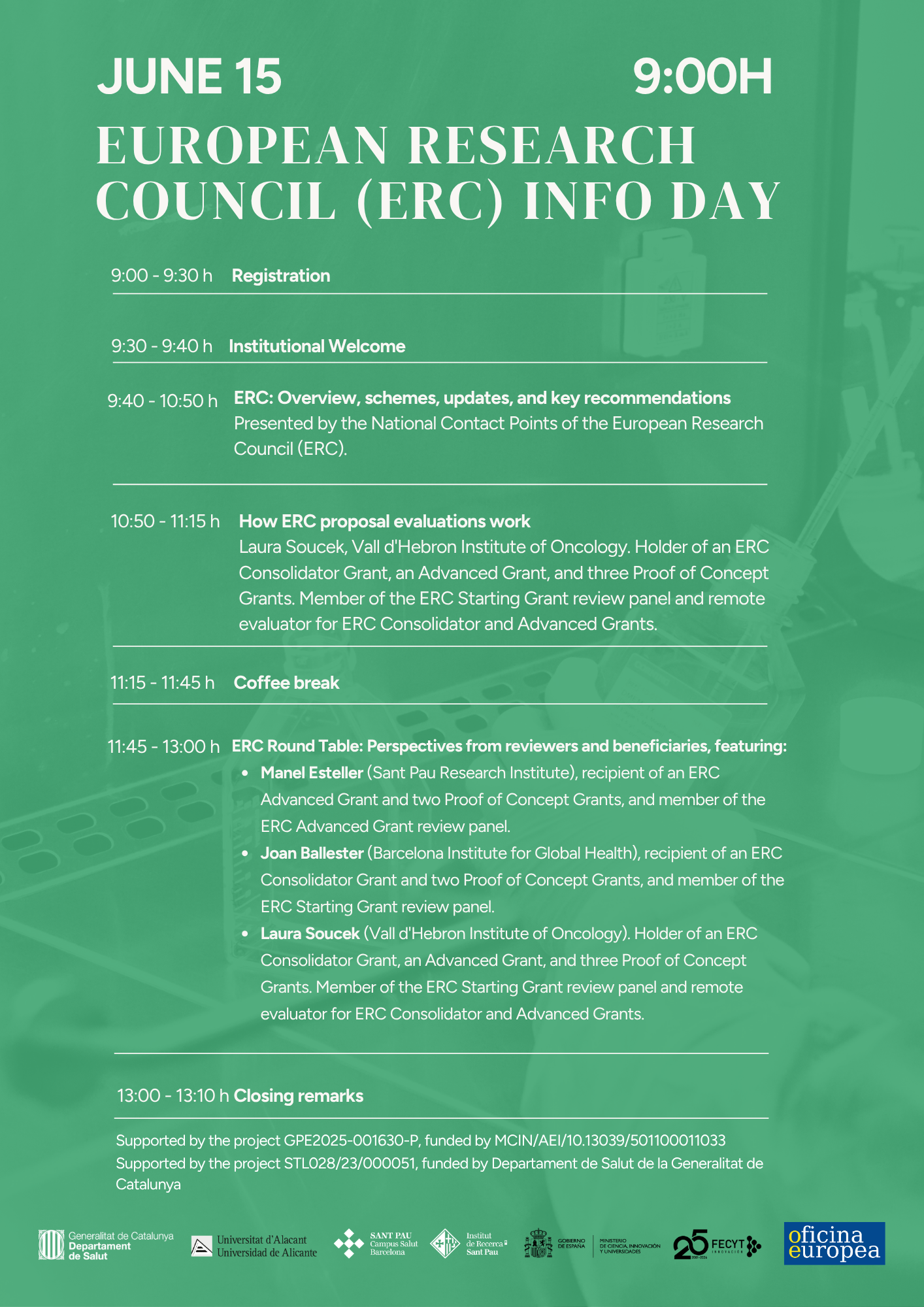
European Research Council (ERC) Info Day – June 15th

On June 15th, we invite you to participate in the information session on the European Research Council, aimed at researchers and research support staff interested in applying for ERC calls.

The event will feature National Contact Points (NCPs), ERC grant recipients, and ERC evaluators and panel members, who will share their experience and recommendations.

The session will provide a practical insight into the application process, evaluation criteria, and keys to preparing a competitive proposal, as well as program updates, including the new ERC Plus grant. Additionally, you can book individual meetings with the NCPs (prior reservation required).

📅 June 15th, 2026, from 09:30 to 13:30 h 📍 Aula Magna – Casa Convalescència, carrer de Sant Antoni Maria Claret, 171, 08041 Barcelona

Register by clicking here.

Check the program by clicking here.

  • Supported by the project GPE2025-001630-P, funded by MCIN/AEI/10.13039/501100011033

  • Supported by the project STL028/23/000051, funded by Departament de Salut de la Generalitat de Catalunya

18:00 h New Seminar at CC Guinardó: How to discover new diseases in the 21st century? – Óscar de la Calle

On Wednesday, May 20, at 6 pm, Óscar de la Calle, a researcher with the Inflammatory Diseases Group at IR Sant Pau and a specialist in the Immunology Department at Sant Pau Hospital, will give a talk at the Guinardó Civic Centre entitled «How to discover new diseases in the 21st century?».

Science has solved many health-related mysteries, but there are still little-known diseases and others that have not even been identified.

In this talk, we will discuss strategies, tools and technological advances that enable us to identify new diseases, as well as the importance of this process for people who live with symptoms of illness every day but without a clear diagnosis.

Join us to learn about two real-life examples of diseases we have discovered in recent years.

Address: Rda. Guinardó, 113-141 Barcelona 08043

Time: 18:00 h – 19:00 h

Sign up


18:00 h New Seminar at CC Navas: Excess sugar has consequences – Joana Rossell

On Tuesday, May 19, at 6 pm, Joana Rossell, postdoctoral researcher with the Endocrinology, Diabetes and Nutrition Research Group at IR Sant Pau, will give a talk at the Navas Civic Centre entitled «Excess sugar has consequences».

Have you ever stopped to think about how much sugar you consume through your diet? Excessive consumption has effects on the body and long-term consequences, as it is a risk factor for the development of diseases such as type 2 diabetes and hepatic steatosis, also known as non-alcoholic fatty liver disease. But why? What is the harmful effect of this excess?

In this talk, we’ll explore the link between sugar and these health conditions.

Address: Ptge. Torent, 1, 08027 Barcelona

Time: 18:00 h – 19:00 h

Sign up


18:00 h New Seminar at CC Guinardó: Thrombosis: a silent threat – Jose Manuel Soria

On Wednesday, April 22, at 6 pm, Jose Manuel Soria, head of the Genomics of Complex Diseases research group at the Sant Pau Research Institute, will give a talk at Guinardó Civic Centre entitled «Thrombosis: a silent threat».

Every minute, someone in Europe dies from thrombosis. That is why, as part of World Thrombosis Day, we want to raise awareness of this disease, which is often invisible but has serious consequences. Thrombosis occurs when blood clots form in the veins or arteries, blocking blood flow. This condition can lead to complications such as heart attacks, strokes or pulmonary embolisms, and is the leading cause of death worldwide related to cardiovascular disease.

Address: Rda. Guinardó, 113-141 Barcelona 08043

Time: 18:00 h – 19:00 h

Sign up


18:00 h New Seminar at CC Navas: The brain’s appetite: the neurobiology of eating behaviour – Romina Miranda

On Tuesday, April 14, at 6 pm, Romina Miranda-Olivos, a postdoctoral researcher with the Endocrinology, Diabetes and Nutrition Research Group at IR Sant Pau, will give a talk at the Navas Civic Centre entitled ‘The brain’s appetite: the neurobiology of eating behaviour’.

The brain plays a very important role in our relationship with the food we eat. Specifically, it is responsible for controlling appetite and the feeling of fullness through signals that regulate our eating behaviour. However, this behaviour is also influenced by emotional, social and psychological factors that can alter our brain’s natural response, leading to disorders such as obesity and anorexia.

Join us to discover what research reveals about what happens in the brain during these situations of imbalance. We will analyse how these brain circuits are regulated and what treatments exist to counteract these imbalances, emphasising the importance of addressing these behaviours with a holistic approach that promotes a healthier relationship with food.

Address:Ptge. Torent, 1, 08027 Barcelona

Time: 18:00 h – 19:00 h

Sign up


18:00 h New Seminar at CC Navas: How are adverse drug reactions managed? – Mayro Cortés

On Tuesday, March 10, at 6 pm, Mayro Cortés, a junior doctor in the Clinical Pharmacology Department at Sant Pau Hospital, will give a talk at the Navas Civic Centre entitled ‘How are adverse drug reactions managed?’.

All medicines can have contraindications and carry a certain risk of causing adverse effects. Do you know what an adverse reaction is and how we manage them, both in hospitals and outside them?

In this talk, we will look at what pharmacovigilance involves, why it is important, and how we can get involved as citizens to identify, as early as possible, serious or previously unknown adverse reactions to medicines that are already on the market.

Address: Ptge. Torent, 1, 08027 Barcelona

Time: 18:00 h – 19:00 h


19:00 h New Seminar at Ateneu El Poblet: What does our blood tell us about our cardiovascular health? – Teresa Padró

On Wednesday, February 25, at 7 pm, Teresa Padró, coordinator of the IR Sant Pau research group on biomarkers of cardiovascular disease, will give a talk at the Ateneu El Poblet entitled ‘What does our blood tell us about our cardiovascular health?’.

Blood carries many biological components. The challenge lies in determining which of these components we can detect and measure through a blood test to assess a person’s state of health—what are known as blood biomarkers.

Biomarkers are a key tool for the diagnosis and monitoring of cardiovascular diseases, and even for assessing the response to certain treatments. In this talk, we will look at real-life examples with applications in clinical practice, as well as the research currently being carried out to advance our understanding of these indicators.

Address: Carrer de Nàpols, 268 – 270, 08025 Barcelona

Time: 19:00 h – 20:00 h

No registration required.


18:00 h New Seminar at CC Navas: The patient as an expert in their own illness – Susan Webb

On Tuesday, February 10, at 6 pm, Susan Webb, former senior consultant in the Endocrinology Department at Sant Pau Hospital and honorary professor in the Department of Medicine at the UAB, will give a talk at the Navas Civic Centre entitled ‘The patient as an expert in their own illness’.

Receiving a diagnosis of a chronic illness raises many doubts and uncertainties and can affect various aspects of daily life. Understanding the patient’s experience and their real-life experience of the illness is essential to achieving high-quality healthcare.

In this talk, we will explore the role of the patient as an expert on their own illness and how educating the patient and those around them is key to understanding the diagnosis, making informed decisions and improving quality of life.

Address: Ptge. Torent, 1, 08027 Barcelona

Time: 18:00 h – 19:00 h


18:30 h New Seminar at Biblioteca Sagrada Familia: If blood cholesterol reaches the brain, it’s a bad sign. Why? – Maria Borrell

On Thursday, February 5, at 6.30 pm, Maria Borrell, a researcher at CIBERCV in the Molecular and Therapeutic Pathology of Atherothrombotic and Ischaemic Diseases Group at IR Sant Pau, will give a talk at Biblioteca Sagrada Familia entitled “If blood cholesterol reaches the brain, it’s a bad sign. Why?”.

Although we have a fairly good understanding of the mechanisms that regulate blood cholesterol, many questions remain unanswered regarding how it is regulated in the brain. This is particularly relevant when we consider that around 20% of the body’s total cholesterol is found in the head, where it is essential for neuronal function.

In this talk, we will explore the link between abnormal cholesterol levels and cognitive decline, and discover how advances in research are helping us to better understand these processes.

Would you like to find out how research is progressing?

Address: C/ de Provença, 480, 08025 Barcelona

Time: 18:30 h – 19:30 h


18:00 h New Seminar at CC Guinardó: Stroke: When blood doesn’t reach the brain – Franco Appiani

On Wednesday, February 4,  at 6 pm, Franco Appiani, a researcher with the Pharmacogenomics and Neurovascular Genetics Group at IR Sant Pau, will give a talk at the Guinardó Civic Centre entitled “Stroke: When blood doesn’t reach the brain”.

Stroke is one of the leading causes of death and disability in Europe. This condition, which affects the blood vessels supplying the brain, can have various causes. Do you know what the main factors are that can trigger a stroke?

Join us for this talk to discover what we know about this disease and reflect on some of the research questions currently being addressed to advance our understanding of what we still do not know.

Address: Rda. Guinardó, 113-141 Barcelona 08043

Time: 18:00 h – 19:00 h


18:00 h New Seminar at CC Navas: Myths and realities about breast cancer – Dani Romero

On Tuesday, January 20, at 6 pm, Dani Romero, a nurse in the Oncology Department at Sant Pau Hospital, will give a talk at the Navas Civic Centre entitled “Myths and realities about breast cancer”.

Breast cancer is the most common cancer among women in Catalonia and, although the five-year survival rate for patients is close to 90%, there has been an increase in cases among younger patients.

In this talk, we will analyse the current situation regarding breast cancer both nationally and internationally, debunk some common myths about the disease, and look at what health recommendations can be followed to prevent it and to treat symptoms when they appear.

Address: Ptge. Torent, 1, 08027 Barcelona

Time: 18:00 h – 19:00 h


18:30 h New Seminar at Biblioteca Sagrada Familia: Biomarkers research – Daniel Alcolea

On Thursday, November 27, at 6.30 pm, Daniel Alcolea, a researcher with the Dementia Neurobiology Group at IR Sant Pau and a neurologist at the Memory Unit of Sant Pau Hospital, will give a talk at Biblioteca Sagrada Familia entitled ‘Biomarkers research’.

What are biomarkers and why are they important? Join us as we explore the latest advances in diagnostic markers for Alzheimer’s disease. Discover the innovative technologies that are transforming our understanding of this disease and bringing us ever closer to better treatments.

Address: C/ de Provença, 480, 08025 Barcelona

Time: 18:30 h – 19:30 h


18:30 h New Seminar at Biblioteca Sagrada Familia: Thrombosis: a silent threat – Jose Manuel Soria

On Thursday, October 16, at 6.30 pm, José Manuel Soria, head of the Genomics of Complex Diseases research group at the Sant Pau Research Institute, will give a talk at the Biblioteca Sagrada Familia entitled ‘Thrombosis: a silent threat’.

Every minute, someone in Europe dies from thrombosis. That is why, as part of World Thrombosis Day, we want to raise awareness of this disease, which is often invisible but has serious consequences. Thrombosis occurs when blood clots form in the veins or arteries, blocking blood flow. This condition can lead to complications such as heart attacks, strokes or pulmonary embolisms, and is the leading cause of death worldwide related to cardiovascular disease.

Join us at this talk to find out how research is advancing our understanding and treatment of this vascular disease.

Address: C/ de Provença, 480, 08025 Barcelona

Time: 18:30 h – 19:30 h


18:00 h New Seminar at CC Navas: What does our blood tell us about our cardiovascular health? – Teresa Padró

On Tuesday, November 18, at 6 pm, Teresa Padró, coordinator of the IR Sant Pau research group on biomarkers of cardiovascular disease, will give a talk at the Navas Civic Centre entitled ‘What does our blood tell us about our cardiovascular health?’.

Blood carries many biological components. The challenge lies in determining which of these components we can detect and measure through a blood test to assess a person’s state of health—what are known as blood biomarkers.

Biomarkers are a key tool for the diagnosis and monitoring of cardiovascular diseases, and even for assessing the response to certain treatments. In this talk, we will look at real-life examples with applications in clinical practice, as well as the research currently being carried out to advance our understanding of these indicators.

Address: Ptge. Torent, 1, 08027 Barcelona

Time: 18:00 h – 19:00 h


18:00 h New Seminar at CC Navas: When the efficacy and toxicity of a treatment depend on your genes – Pau Riera

On Tuesday, October 7, at 6 pm, Pau Riera, hospital pharmacist and researcher at IR Sant Pau within the Genetic Diseases group, will give a talk at the Navas Civic Centre entitled ‘When the efficacy and toxicity of a treatment depend on your genes’.

It is well known that medicines do not work the same for everyone, but do you know why? Genetic factors are decisive in the response to drug treatment and explain much of this variability between individuals.

In this talk, we will explore the clinical relevance of pharmacogenetics, the discipline that studies the influence of DNA variations on drug response and toxicity.

Furthermore, we will look at some examples that have already been implemented in hospitals and which contribute to progress towards increasingly personalised medicine, leading to a more effective and safer use of medicines.

Address: Ptge. Torent, 1, 08027 Barcelona

Time: 18:00 h – 19:00 h


18:00 h New Seminar at CC Guinardó: The kidneys: much more than a filter – Beatriz Bardaji

On Wednesday, October 22, at 6 pm, Beatriz Bardaji, coordinator of studies and clinical trials and postdoctoral researcher at the Puigvert Foundation and IR Sant Pau, will give a talk at the Guinardó Civic Centre entitled ‘The kidneys: much more than a filter’.

The kidneys, although often described as filters for removing waste, do many other things. They also have essential hormonal and regulatory functions for life. In this talk, we will explain how this very important organ works and why it is key to our health.

Come and discover why the kidneys are much more than a filter!

Address: Rda. Guinardó, 113-141 Barcelona 08043

Time: 18:00 h – 19:00 h


19:00 h New Seminar at Ateneu El Poblet: DNA scissors: how do we edit the genome in the laboratory? – Gerard Muñoz-Pujol

On Wednesday, June 25, at 7 pm, Gerard Muñoz-Pujol, postdoctoral researcher at IR Sant Pau within the DNA Repair Syndromes and Cancer Predisposition research group, will give a talk at the Ateneu El Poblet entitled ‘DNA scissors: how do we edit the genome in the laboratory?’.

Many diseases have a genetic origin, but the exact cause is often unknown, making diagnosis a real challenge and forcing people to endure a diagnostic odyssey. To diagnose such a disease, it is necessary to analyse DNA to detect the responsible mutations. However, we often encounter variants of uncertain significance, where we do not know if they are actually the cause of the disease. How can we prove it?

In this talk, we will explore how research helps to identify potential genetic alterations in some of these diseases using genome sequencing technologies, and how we use genetic editing tools such as ‘DNA scissors’, also known as CRISPR technologies, to generate genetically edited cell models and study these mutations.

Address: Carrer de Nàpols, 268 – 270, 08025 Barcelona

Time: 19:00 h – 20:00 h

No registration required.


18:30 h New Seminar at Biblioteca Sagrada Familia: The benefits of the Mediterranean diet on cholesterol – Sònia Benítez

On Thursday, June 19, at 6.30 pm, Sònia Benítez, researcher at IR Sant Pau within the Cardiovascular Biochemistry Group, will give a talk at Biblioteca de la Sagrada Familia entitled ‘The benefits of the Mediterranean diet on cholesterol’.

Our diet and lifestyle can act as protective factors or cardiovascular risk factors, depending on our habits. Do we exercise regularly? Do we eat a healthy diet? The advantage of habits is that they can be changed, and so we can work on them to prevent the development of diseases such as atherosclerosis, a degenerative process affecting the blood vessels characterised, amongst other things, by the build-up of cholesterol and triglycerides.

Dietary fat is transported through the blood by particles called lipoproteins, better known as ‘good’ cholesterol (HDL) and ‘bad’ cholesterol (LDL). However, it is not just the quantity, but also the quality that determines the progression of cardiovascular diseases.

Join us to discover what atherosclerosis is and how to prevent cardiovascular diseases by regulating blood cholesterol levels through the Mediterranean diet and other healthy habits!

Address: C/ de Provença, 480, 08025 Barcelona

Time: 18:30 h – 19:30 h


Mariona’s Adventure Returns to Inspire Scientific Vocations

Following the success of the first edition, which brought together more than 3,000 participants, the Sant Pau Research Institute (IR Sant Pau) is launching the second edition of Mariona’s Adventure—an educational and science outreach project designed to inspire children and teens to pursue scientific careers and to break gender stereotypes that often discourage girls from entering the world of research.

This year, Mariona is back with three new missions taking place in July, September, and November, culminating in a grand celebration on February 15, 2026, as part of the International Day of Women and Girls in Science. The event aims to honor scientific talent with a gender perspective.

The first event will be held on Saturday, July 19, at Tibidabo Amusement Park, with a fun and participatory day focused on the digestive system. Through workshops and activities designed by professionals at IR Sant Pau, children and families will learn how the digestive system works and take part in educational experiments and games.

A major highlight of this second edition is that one of the missions will take place at the Barcelona Zoo in September, reflecting the project’s commitment to expanding its locations and reaching new audiences in educational and accessible environments.

All activities are free and open to the public, and will be led by professionals from IR Sant Pau—researchers, healthcare professionals, technicians, and students—who will share their knowledge in a close and engaging way. Children and teens will accompany Mariona, an eight-year-old girl passionate about science, on an adventure filled with challenges related to the human body, health, and biomedical research.

More information is available on the website:
https://www.santpau.cat/es/web/public/mariona-investigadora

The first edition of “Mariona’s Adventure” featured three science-themed family events at the Tibidabo Amusement Park—held on July 20, September 21, and November 24, 2024—where children and families took part in interactive workshops, talks with female researchers, and educational missions to “activate” organs such as the brain, heart, muscles, and blood. All of these activities culminated in a grand finale on February 9, 2025, at Tibidabo, where more than 2,500 people came together to celebrate the International Day of Women and Girls in Science in a festive, family-friendly atmosphere.

The Mariona project

Mariona the Young Researcher is an educational and outreach initiative developed by IR Sant Pau. Mariona is a character who represents an eight-year-old girl passionate about science and medicine. Her goal is to inspire children and teens to explore the world of scientific research. At the age of eight, girls often begin to lose interest in science, due to persistent stereotypes and a lack of role models—something this project aims to address.

Through a series of missions and challenges designed to take place at Tibidabo Amusement Park and the Barcelona Zoo, Mariona encourages children to discover the secrets of the human body. They participate in scientific experiments and learn the importance of adopting a healthy lifestyle.

The project also highlights the role of women in science, showcasing real examples of female researchers who share their professional and personal experiences to promote gender equality in the field.

Science with a gender perspective

IR Sant Pau actively promotes ongoing dialogue with society, in line with its RRI (Responsible Research and Innovation) plan and its goals for Science Education and Public Engagement. As a CERCA center and a Scientific Culture and Innovation Unit accredited by FECYT, its commitment to bringing research closer to society is unwavering. As the only research institute in Catalonia with a cross-cutting gender research program, IR Sant Pau serves as a spokesperson for the latest scientific advances. It emphasizes the importance of gender-focused research and the role of women in science and the future of a more inclusive scientific community.

Second edition activity calendar:

  • July 19, 2025 – Tibidabo Amusement Park: Mission focused on the digestive system
  • September 27, 2025 – Barcelona Zoo: Mission focused on the nervous system
  • November 22, 2025 – Tibidabo Amusement Park: Mission focused on the respiratory system
  • February 15, 2026 – Grand finale at Tibidabo Amusement Park, coinciding with the International Day of Women and Girls in Science

18:30 h New Seminar at Biblioteca Sagrada Familia: Excess sugar has consequences – Marina Rojo and Maria Antentas

On Thursday, May 15, at 6.30 pm, Marina Rojo and María Antentas, researchers at the Sant Pau Research Institute, will give a talk at Biblioteca Sagrada Familia entitled ‘Excess sugar has consequences’.

Have you ever stopped to think about how much sugar you consume through your diet? Excessive consumption has effects on the body and long-term consequences, as it is a risk factor for the development of diseases such as type 2 diabetes and hepatic steatosis, also known as non-alcoholic fatty liver disease. But why? What is the harmful effect of this excess?

In this talk, we’ll explore the link between sugar and these conditions, and compare 3D models of a healthy liver and one with fat accumulation to see the differences. You’ll also take part in a collaborative activity to classify various foods according to their sugar content. It’s surprising just how much some of them contain!

Join us and discover how to reduce the amount of sugar in your daily life without giving up the pleasure of eating!

Address: C/ de Provença, 480, 08025 Barcelona

Time: 18:30 h – 19:30 h


This website uses cookies to improve the browsing experience and perform analytical tasks. If you continue browsing, we understand that you agree our cookies policy. More information